Wed,Jun,24,2026
Stephen Hawking was fond of taking apart clocks and radios when he was a child to explore mechanical principles; Jane Goodall spent four hours in a chicken coop at the age of five to observe a hen laying an egg... You can never tell "what's the use of this research" or "is it helpful for college entrance exams", but many scientists had their own "non-utilitarian" interest in science and technology during their childhood. From October 20 to 24, the CHES Primary School held the second campus science and technology festival, with the theme of "Science and Technology Together, Children Creating the Future", aiming to inspire students' interest in scientific and technological innovation and exploration of the future.
At the opening ceremony, science teachers led teachers and students to review China's latest achievements, such as "artificial sun", Dream No.1 drilling ship, and the application of AI technology in medical care and new material research...
Students showed their talents and submitted their own inventions to participate in the school's science and technology creation exhibition: building a "future playground" with their own hands to demonstrate the power of clean energy sources such as solar, wind and hydropower; entering the creative workshop to turn their ingenious ideas into practical small creations; becoming science popularization experts and participating in the "science popularization knowledge competition".
Primary school student Chen Renchuan made his ideal model of "West-to-East Power Transmission" this year: generating, transmitting and storing electricity by using solar and wind power. "The inspiration came from what I saw and heard during my summer vacation trip to Xinjiang. I saw windmills, cables, power towers and thermal power plants there with my mother, which aroused my strong interest." Huang Junyao made a lifelike model of the Zhurong Mars rover based on what was displayed at the Zhuhai Airshow.
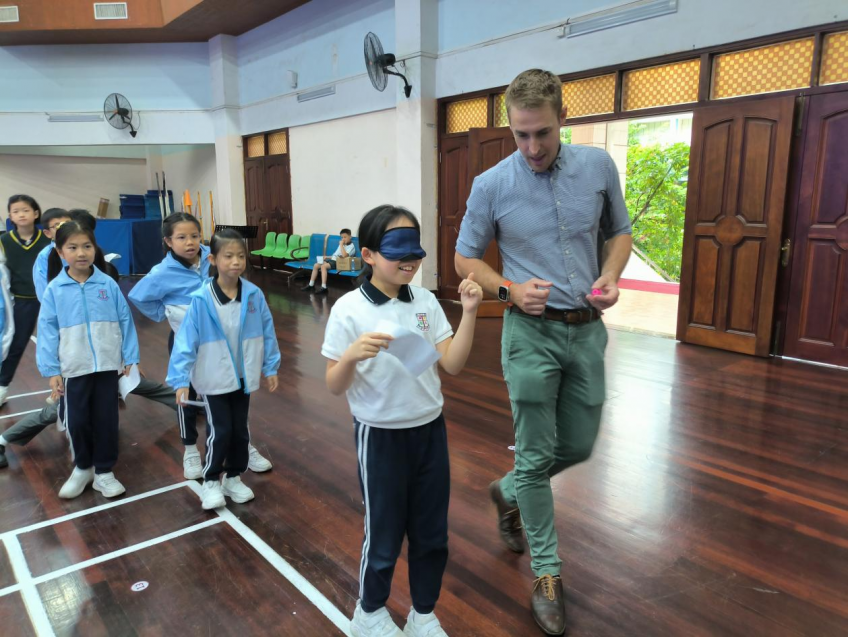
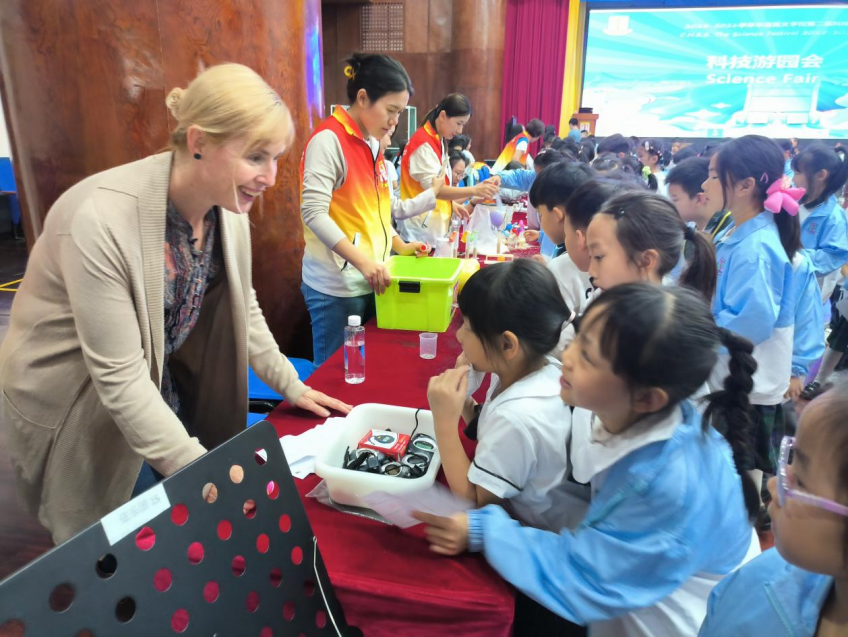
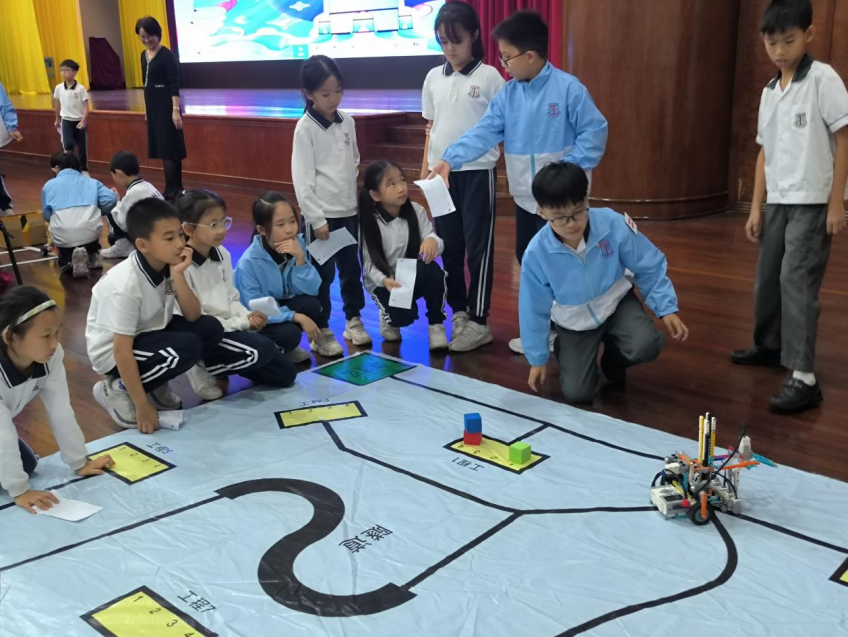
When it came to the science and technology fair, students experienced various activities. There were interactive games and projects such as model aircraft flight control, programming games, Shulte grid games, static electricity balls, kaleidoscope paradise, parking lot exit challenge, electric shock maze, and robot village. All these dazzling interactive mini-games and projects were designed and created by the students themselves. Among them, the most popular one was "Robot Village" -- students came in droves to watch and control the iron rhinoceros, robot dogs, and remote-controlled tool vehicles.
On the open ground behind, Yang Mochen and Guo Minyan's project "Road Engineering" attracted many boys. The two students explained the principle of the project: "We have programmed it on the computer and then input it into an e6rcu mainframe, which is the 'brain' of the automatic engineering vehicle. Once it's assembled, just press the start button and it will automatically complete all the tasks." This summer vacation, they won the first place in the city and the first prize in the province in the primary school group in a certain robot innovation competition with this project.
When ingenious ideas meet scientific principles, the students' works may not be precise enough or may seem immature, but a future exploration journey belonging to the children has already set sail.
About our school International Education Campus culture Campus Video Contact us
Copyright © 2018-2019 Zhongshan Daily Newspaper Group. All rights reserved. Presented by zsnews.cn